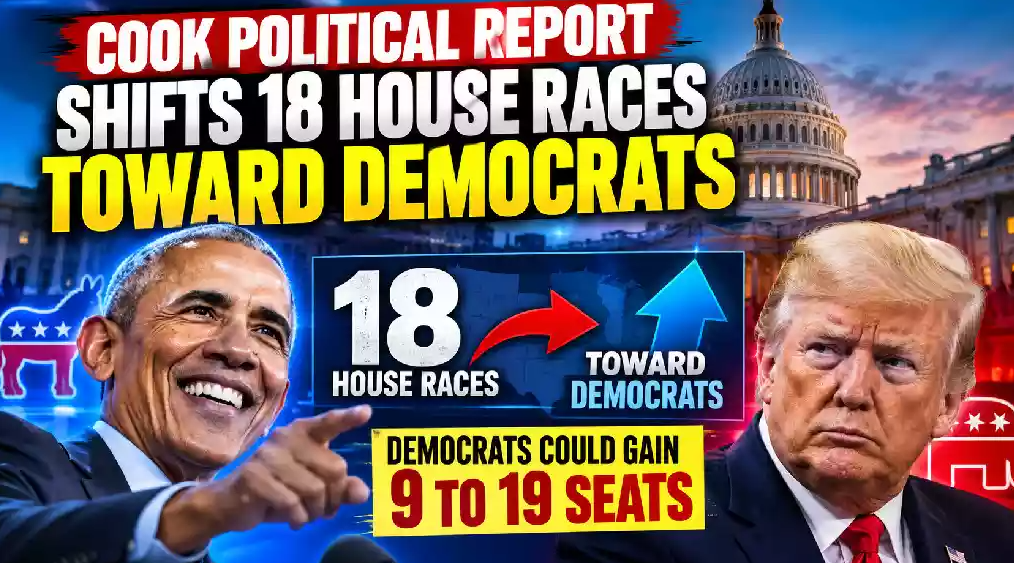
A new Cook Political Report analysis has moved 18 House races in Democrats’ direction, adding to signs that control of Congress may be competitive in November. The shift is a forecast adjustment—not a result, and not a guarantee that Democrats will take the House.
Axios reports the ratings changes include districts in several states, among them Iowa, Pennsylvania, Washington, Michigan, North Carolina and Virginia. Cook’s broader outlook points to a possible Democratic gain of nine to nineteen seats, while Republicans still hold advantages in campaign resources.
What the House races forecast means
Ratings analysts look at polling, district history, candidates and the political environment to estimate how competitive a race may be. When a rating moves, it means the analyst sees a changed balance of evidence. It does not mean that every district is now likely to change parties.
The possible seat range matters because a narrow shift in a small number of districts can determine which party controls the chamber. But the final outcome depends on turnout, candidate performance and events still ahead. Forecasts will continue to change as new information arrives.
Why Democrats may see an opening
National dissatisfaction and voter enthusiasm could give Democrats a favorable climate in some districts. Competitive races can also emerge where an incumbent faces a stronger challenger or where local conditions diverge from the state’s usual pattern.
Still, Republicans have not stopped campaigning. Axios notes that GOP candidates and aligned groups retain significant financial resources. Money can pay for organizing and communication, though it cannot guarantee that voters agree with the message.
What local voters should compare
National ratings can draw attention to a race, but constituents should look at what each candidate says about local needs. Jobs, health costs, public safety and federal spending may matter differently from one district to another.
Voters can also compare campaign claims with voting records and official budget documents. A forecast does not tell people how a member would vote on a bill; it only estimates the likelihood of winning the election.
The race is still unsettled
The movement is worth watching because the House majority may be decided by a handful of seats. Yet the most accurate summary is that analysts see more Democratic opportunities than before—not that a takeover is certain.
Keep an eye on updated ratings, fundraising reports and district polling over the next few weeks. Our earlier midterm coverage explains another campaign issue, while this report looks at Trump’s election-season appearances.
Why forecasts can move quickly
A rating change can follow new polling, candidate developments or a shift in the national environment. Analysts may also react when campaigns change their spending plans or when a local issue draws unexpected attention. That is why readers should treat a forecast as a living estimate rather than a fixed prediction.
Even a strong national trend can look different across districts. A candidate’s local reputation, the composition of the electorate and the quality of each campaign all affect the result. The House majority will come from individual races, not from a single nationwide popular vote.
Campaign finance can offer another clue, but it also needs context. A large reservation may include a future plan rather than money already spent, and spending by a party committee is not the same as a candidate’s own budget. Readers should check what the figures measure before drawing conclusions about who is winning.
Ultimately, the forecast will be tested by ballots. Until then, it is a tool for understanding where analysts see uncertainty, not a substitute for the election itself.
After the next rating update, compare which races moved and which stayed stable. The pattern may be more informative than a single headline number.
District-level reporting can help fill in what a national forecast leaves out. Local debates, endorsements and candidate visits may show how a race is changing before a national rating catches up. Those details are useful, but they still need to be weighed against the actual vote when ballots are counted.
Source: Axios reporting, October 9, 2026.